


Learning to see what’s already moving
Some days it feels like I’m standing in a blizzard of good intentions.
Emails, grant proposals, meeting notes, invitations — all swirling so thick I can’t tell what’s moving and what’s stuck. The world turns white, and it’s hard to tell up from down; forward from backward.
I had a meeting recently where that white-out showed up again.
Half the group kept saying: “dead in the water” — “we’re spinning our wheels!” The other half (quietly) pointed out that we’d actually done almost everything we said we’d do: building relationships, hosting circles, writing grants, clarifying shared expectations.
But because the work didn’t lead to the tidy payoff we’d imagined — a big check, a public splash, the magical surge — it didn’t count.
That’s when the conditioned responses show up.
Money!
That’s the problem.
We need money.
If we had money, all our problems would be solved!
Then it would work! Then people would notice us and do what we tell them to!
It turns out that when we lose the ability to see movement, we start confusing money with motion.
Money is the only flow we know how to measure, so we keep waiting for it to come our way before we’ll let ourselves be alive to the real flows already happening.
Lately I’ve been thinking that what we’re missing isn’t funding or motivation, but mirrors.
Complex systems need mirrors to help see themselves. Without them, we mistake living in complexity for failure.
In a healthy ecosystem, reflection is how the body acknowledges its own heartbeat.
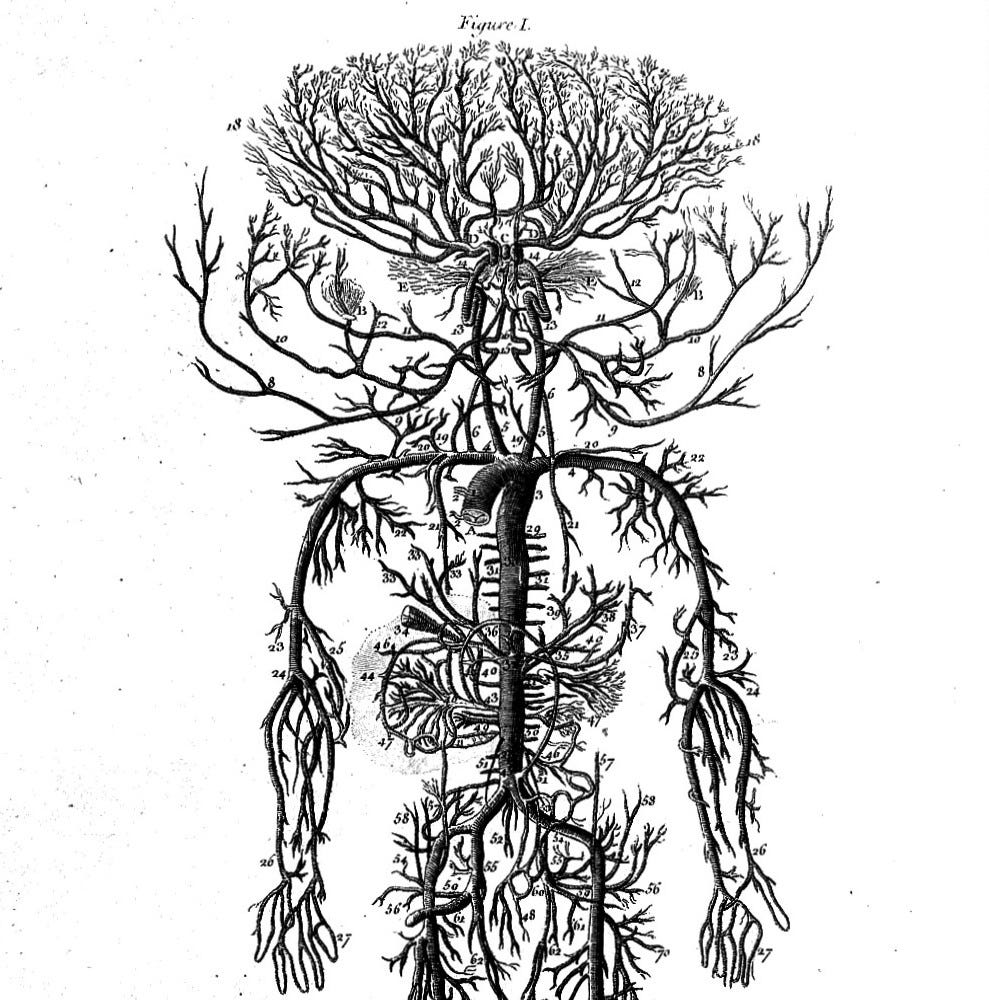
That got me thinking about mapping — not the tidy kind with straight lines that all point towards a single goal (all roads lead to Rome!), but something more like a circulatory diagram.
I want to see flows, not profiles.
Every organ in the body transforms what moves through it: lungs capture energy from the atmosphere, the muscles turn glucose into power.
So, how do we map the organs that fuel collective change? Outreach transforms opportunity into curiosity. Storytelling turns experience into motivation.
A network map shows connections; an organ map shows metabolism.
So, what does this have to do with white-out conditions? How do we stay oriented when it all starts swirling around?
I keep thinking of the dancer’s trick: when you spin, you pick a fixed point on the horizon and keep spotting it, over and over, so you don’t get dizzy.
Maybe that’s what these maps are for — a way to fix our gaze on the far point so we can move without losing our balance.
The goal isn’t to capture the system, it’s to stabilize perception long enough to feel the real motion again.
So, how can I create that point on the horizon? Start small: a handful of organs, a few colored arrows for trust, time, and attention. Just a dot, really.
I hope when I show it to people, they stop talking about “dead in the water.” They start pointing to flows. “Look, this connects to that!”
It was there all along, of course, but just because you know how magic works doesn’t make it any less magical.
Daily Koan
Maybe the new economy isn’t something we have to invent from scratch.
Maybe it’s already here, circulating quietly between us, waiting for the body to notice.
What if wealth isn’t what moves,
but the ability to see what’s already moving?